
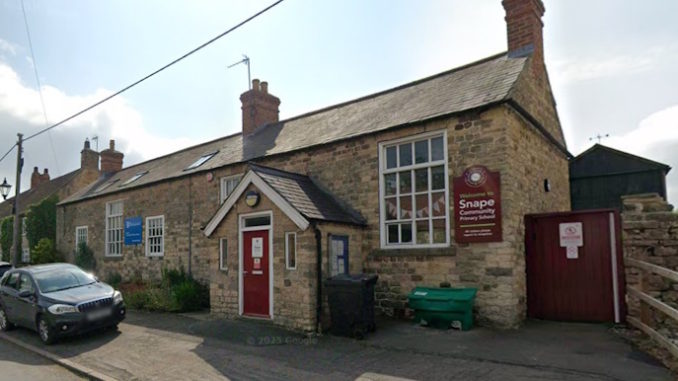
Two village primary schools could be merged into a single school operating across both sites under a plan to secure their future and keep them legal.
Under the proposal, Snape Community Primary School and Thornton Watlass Church of England Primary School would become one school from April 2027.
Younger pupils would be taught at Snape and older children at Thornton Watlass.
The plans, drawn up by the schools’ shared governing board, follow legal advice received by North Yorkshire Council that their current arrangements do not comply with legislation governing school admissions and pupil registration.
The two schools operate as a federation, sharing leadership and teaching arrangements to cope with falling pupil numbers.
However, the arrangement involves some children being taught at a school other than the one that they are officially registered at.
According to a report prepared for councillors, legal advice received in summer 2024 concluded this arrangement was not allowed.
The governing board has considered four alternative options, including continuing as separate schools, closing one site entirely and restructuring the schools into separate infant and junior schools.
It has recommended merging the schools while retaining both buildings.
Under the proposals, Snape Community Primary School would technically close, with Thornton Watlass Church of England Primary School expanding to operate across both sites.
Nursery, reception and key stage one children would be educated at Snape, while pupils in years three to six would attend Thornton Watlass.
Children would normally move between the sites at the start of year three, although the school would retain flexibility to change arrangements depending on pupil numbers.
The merged school would retain its Church of England designation, subject to diocesan approval, and the two existing catchment areas would be combined.
Council figures show that Snape has 28 pupils on roll, compared with just eight at Thornton Watlass.
The schools have capacities of 52 and 51 pupils respectively.
A combined school is forecast to have 45 pupils by the 2028/29 academic year.
The governing board stated there were insufficient pupils to run separate classes covering all seven primary year groups at both schools without affecting the quality of education.
It also found that closing one site and moving all pupils to the other would result in a significant reduction in funding.
Operating as one school across two sites was considered the most financially sustainable option, although the report acknowledges that overall revenue funding would still fall.
The council says the proposal would also allow the schools to continue offering classes with children of similar ages.
School transport arrangements would be considered under the council’s existing policy, while the governing board believes its budget could cover necessary transport between the two sites.
North Yorkshire Council’s executive member for education is being asked to approve a six-week public consultation when the proposal is considered on October 27.
If approved, consultation would begin on November 9 and close on December 18, with a public meeting held during that period.
The council’s executive is expected to consider the responses in January, with a final decision anticipated by the end of March.
Be the first to comment