

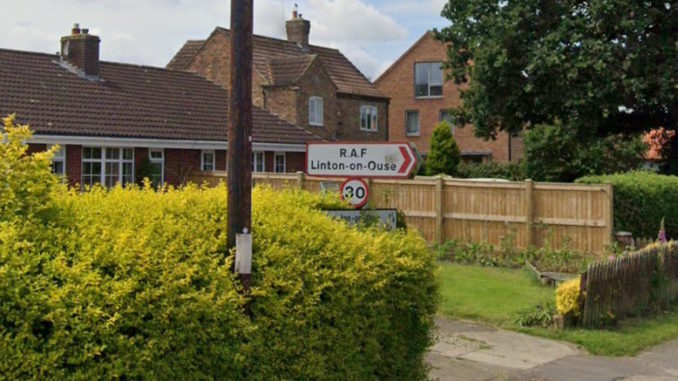
The Government’s decision to give the go-ahead for an asylum centre at a former military base in Oxfordshire has heightened concerns among residents fighting similar proposals for Linton-on-Ouse.
Members of the Linton-on-Ouse Action Group fear the decision could signal the government’s intentions for the former North Yorkshire RAF station where plans to accommodate asylum seekers have faced strong local opposition.
Professor Olga Matthias, of the action group, described the Piddington decision as “not a great sign” for Linton-on-Ouse.
However, she said the wider issue was the government’s approach to asylum accommodation, arguing that moving people out of hotels and into former military bases failed to address the underlying problems.
She said: “It’s more a reflection of the inadequacies of the government and its policies than anything else.
“What they’re doing by moving people from hotels to former military bases is effectively rearranging the deckchairs on the Titanic.
“They’re not actually addressing the issue. There’s a hole in the ship, but instead of fixing it, they’re just fiddling around on the top.”
Professor Matthias added: “They’re not grappling with the immigration issue — they’re posturing to be seen to be doing something.”
The decision has also prompted criticism from other members of the action group on soicial media, who questioned whether ministers had properly considered the consequences for communities living near the proposed accommodation sites.
One person said: “It is shameful that these decisions can go ahead without them having ever visited the sites themselves.
“They have genuinely no idea of the impact this has on people’s lives.”
Another expressed fears that the decision at Piddington could be repeated in North Yorkshire.
They said: “They are not interested in anyone’s concerns or views. It was always going to be this way, and I fear the same for Linton.”
A further resident accused the government of making a politically motivated decision, claiming that the location of the proposed centres in constituencies not represented by Labour MPs had influenced its approach.
However, not everyone agreed that asylum accommodation would necessarily cause problems for neighbouring communities.
One commentator argued that concerns about crime and pressure on local services had not been borne out in other areas accommodating asylum seekers.
They said: “The only impact asylum accommodation has had in other areas has been the nasty division of the local community caused by far right groups, mostly from outside the area, coming in to stir it up.
“There has been little or no evidence of crime and no noticeable impact on local services.
“I do understand why people are concerned at such a large number of young men arriving in the village, but there really should be very little, if anything, to worry about.”
Planning permission has been granted on a temporary basis for up to 10 years for the Oxfordshire site, allowing the former military site to accommodate up to 1,256 adult male asylum seekers.
In approving the scheme, the government acknowledged concerns about the impact on the neighbouring village, which has a population of around 350, including pressure on local services, infrastructure and community cohesion.
However, ministers concluded that the overriding national need for asylum accommodation and the government’s aim of reducing reliance on expensive hotels, outweighed the potential local harm and more than 3,100 objections lodged against the proposals.
Be the first to comment