
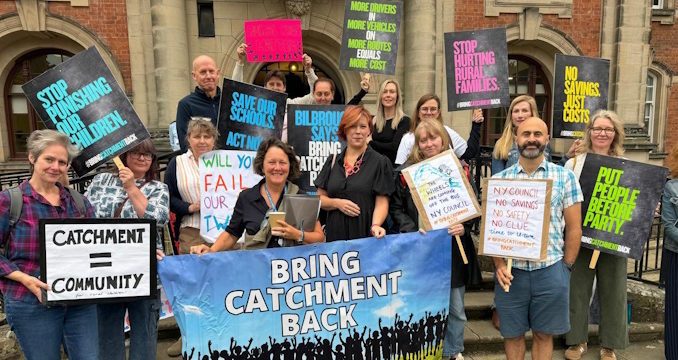
Significant changes are being proposed to North Yorkshire Council’s controversial home-to-school transport policy following a review by senior officers.
Council chiefs say they have listened to parents and other critics of the policy — which limits free school transport to a child’s nearest school only — and proposed a range of improvements.
These include a recommendation to remove five routes along remote roads in the Yorkshire Dales from maps of potential school routes.
The use of Fleet Moss Road, Buttertubs Pass, Kidstone Pass, The Stang, and the road between Keld in Swaledale and Kirkby Stephen has been one of the most contentious issues for parents who say the roads are treacherous in winter.
The post-implementation review into the policy change agreed in 2024 also recommends a range of other changes.
These include improvements to mapping and route information, a stronger appeals process and greater clarity over how routes and distances are assessed.
Information, guidance and communications for families would also be improved.
The council’s digital mapping system calculates which school is closest using roads, footpaths, bridleways and public rights of way.
The review recommends retaining that system but allowing greater flexibility when a route is found to be unavailable, impractical or unreasonable.
Parents would be able to challenge a route through the appeals process and, if it was found to be unsuitable, it could be permanently removed from the mapping system so other families were not affected by the same issue.
There would also be changes to the appeals procedure, with senior officers involved from the first stage and additional training introduced in an attempt to ensure discretion is applied more consistently in exceptional cases.
The notice given to families when a transport permit is withdrawn during an academic year would increase substantially, from seven days to 30 days.
The review also addresses concerns about how distances to schools outside North Yorkshire are calculated.
Where possible, the council would measure to entrance points supplied by the neighbouring local authority.
Where that information was unavailable, the school’s official location in national address data would be used.
In total, the review makes 24 recommendations, but proposes that free transport eligibility should continue to be based on a child’s nearest suitable school and available places, rather than the previously used catchment system.
North Yorkshire Council’s executive member for education, learning and skills, Councillor Annabel Wilkinson, said the council was aware that the policy change had affected some households more than others.
She added: “When the policy changed, we promised to review how it was working in practice and to listen to the experiences of families. That is exactly what we have done.
“We have carefully considered feedback from parents and carers, schools and other stakeholders, alongside appeals, complaints and operational data.
“The review shows the policy is meeting its objectives, but it has also highlighted areas where we can make improvements. We are committed to learning from people’s experiences and ensuring families have clearer information and a better experience of the service.”
The recommendations resulting from the 120-page review were immediately criticised, however, by opposition councillors.
Councillor Peter Lacey, Liberal Democrat group leader and leader of the opposition on the authority, said: “This is a huge opportunity missed. Parents need certainty, and they need a system that is fair and straightforward — not one that is unjust, overly complicated and difficult to navigate.
“We have waited a very long time for this review, and throughout that time parents, schools and the council’s own evidence have made the injustices built into this policy increasingly clear. Yet I simply don’t think what is being proposed comes anywhere close to addressing them.
“Instead of tinkering around the edges, the council should have listened to what parents have been saying all along and looked at how we restore a genuinely fair system that families can understand and rely on.”
The School Transport Action Group, which was formed to oppose the policy change, described the review as “nothing more than rearranging the deckchairs on the Titanic”.
Jo Foster, spokesperson for the group, added: “All the council is proposing to do is add even more complexity and cost to compensate for its own mistakes and patch up a policy that was never fit for purpose and never will be.
“The council has now admitted a catalogue of errors, but is making no plans to revisit the families who have been wronged over the last two years. And 99 per cent of the problems inherent in this policy are still sitting there, unresolved. How much longer is this council going to put parents through this torture?”
“Parents have been clear from day one: they want the simple, fair system that worked for decades.”
Any policy changes would not take effect before September 2027 and would apply to children starting in Reception and Year 7 in September 2028.
The report will be considered by the council’s children and families overview and scrutiny committee on Wednesday next week.
It will then be discussed by the council’s executive on Friday next week.
If agreed by the executive, a six-week public consultation is then due to be launched later this month.
The review’s recommendations would then be considered at a full council meeting in November.
Be the first to comment