

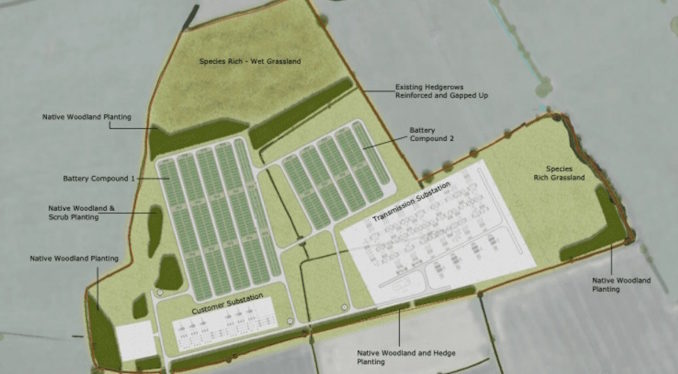
Campaigners opposing a battery energy storage system (BESS) planned for the North Yorkshire countryside say new figures raise questions about whether the scheme is needed.
The group fighting the proposed Mowbray BESS scheme has highlighted an Ofgem update which reveals that there are already far more battery projects planned across Britain than the country is forecast to require.
NatPower has submitted a planning application to North Yorkshire Council for a 1GW BESS near East Rounton, between Northallerton and Yarm.
BESS plants store electricity from the grid at times of lower demand and release it back to the grid when it is needed most.
NatPower, which has also filed an application for a similar BESS scheme at South Kilvington, near Thirsk, says the facilities make an essential contribution to ensuring reliable, secure and affordable electricity for the country.
But campaign group, Protect Northallerton, Yarm & Our Villages, says around 90GW of battery storage is either already operating or in the reformed grid connections queue, compared with a projected requirement of around 29GW by 2035.
The group also points to National Energy System Operator figures which it says indicate the total could potentially reach around 121.5GW if projects currently in the system do not drop out.
Campaigners say the figures should prompt greater scrutiny of whether further battery schemes, including the Mowbray development, are necessary.
Andrew Sheldon-Thomson, from the campaign group, said: “Ofgem and the Government are clear – the battery pipeline is already too big and it threatens to lift bills.
“But planning policy still pushes councils to sign off more projects. It makes no sense to call it an oversupply one minute and force through unnecessary schemes the next.”
The group says the issue is particularly relevant following changes to national planning policy in August which it says increased support for battery storage developments.
The campaigners are opposing the proposed Mowbray BESS and say the latest national figures strengthen their argument that the need for individual battery developments should be more closely examined.
Mr Sheldon-Thomson added: “In the rush to net zero, planning rules stop councils from asking whether a battery scheme is actually needed. The result is that unneeded projects are rubber-stamped as ‘green’ and forced through planning.”
The Local Democracy Reporting Service has contacted NatPower for a response.
Be the first to comment