
For Bilsdale mother-of-three Laura Seales, the issues surrounding North Yorkshire’s home-to-school transport policy are not simply about lines on a computer-generated map.
They mean explaining to her four-year-old daughter why she cannot travel to school with her big sister, while preparing to argue at an appeal next month over an ‘available route’ Laura says no parent would realistically expect a young child to use.
“It’s the upset of it all as well,” she said.
“My daughter, who started school this term, just presumed she was going with her sister, and then she was upset because she couldn’t go in the taxi.”
Laura has been told she will not be offered free transport to Helmsley Primary School, which her eldest daughter already attends, and is challenging the decision.
At the heart of her case is the way North Yorkshire Council calculates a child’s nearest suitable school using the shortest available walking route.
Laura believes the approach simply does not work for isolated rural communities.
“I understand that in an urban area, in towns and cities, the shortest available walking route probably works, and it probably works really well,” she said.
“But I think for rural areas like where we are, it’s just not fit for purpose.”
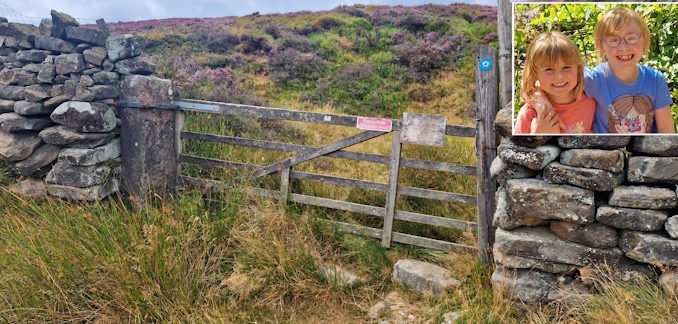
She says the route being used in her daughter’s case crosses challenging moorland.
“In winter you’ve got the snow, and it is a grouse moor, so during shooting season you’ve got people up there shooting and in summer there’s adders — and you’re expecting a four-year-old to walk up there.
“Even with an adult, I still don’t think it’s safe. You just wouldn’t do it. Surely it’s a welfare issue.”
In response, the council points out that it’s not actually expecting children to walk these so-called available routes.
Parents say then why on earth have they been used to decide eligibility?
Laura says her case is all the more frustrating because children attending the family’s nearest school in Chop Gate also attend a school in Carlton-in-Cleveland two days a week, which is further away than Helmsley Primary.
Her experience is one of a number being highlighted by campaign group STAG as North Yorkshire Council continues to implement its revised home-to-school transport policy, which it introduced in a bid to reduce its annual school transport bill of more than £52m.
And while families whose children started school this September continue to challenge decisions, a fresh problem is emerging for parents choosing secondary schools for September 2027.
Changes to the council’s mapping data mean some families are now finding that the order of their nearest schools has changed.
In North Richmondshire, STAG says some Darlington schools are appearing closer while Richmond schools have moved further down families’ lists.
In one case seen by the campaign group, Carmel College in Darlington has moved around 164 metres closer following changes to the data.
Another parent told STAG the school considered nearest for one child who started last September is no longer deemed nearest for their younger sibling.
“I haven’t moved, the schools haven’t moved, but now I’m being told that if I want transport I have to put my two children in two different schools in two different counties,” the parent said.
“This is a joke.”
The changes follow corrections to the data underpinning the council’s calculations.
According to STAG, the council acknowledged in July that entrance information for 24 North Yorkshire schools contained errors, including gates recorded in the wrong places and missing entrances.
Information for schools outside North Yorkshire has also been updated after equivalent school-gate information had not previously been available and different reference points had been used.
STAG argues correcting inaccurate data is necessary, but says the changes demonstrate how difficult it has become for families to plan ahead.
A STAG spokesperson said: “This is the worst year yet for families trying to navigate the school admissions process.
“Parents have been left trying to make decisions while the information underneath those decisions is changing.”
The group also continues to question routes it says involve unsuitable terrain and river crossings, arguing families should be able to see the routes and coordinates underpinning decisions.
“Correcting the school gates is clearly necessary. But it doesn’t solve the fundamental problem,” the spokesperson said.
“If the system can still include a route that a child cannot safely use, then changing the entrance point doesn’t make the calculation reliable.”
Further change is coming, with STAG pointing to plans for a new mapping system from May 2027.
For campaigners, the answer should ultimately be a return to a catchment-based transport system.
“This isn’t a plaster that needs putting over the cracks,” the spokesperson said.
“It needs a wholesale reset.
“Parents should not have to check which version of a computer map is being used to know where their child can go to school.
“They need certainty – and so do schools.”
The council says the changes were introduced to make the service financially sustainable, fair to families and in line with government guidance.
A post-implementation review has now resulted in 24 recommendations, with a consultation underway which focuses on seven proposed changes which will ultimately be considered by full council.
In response to the latest criticism from STAG, North Yorkshire Council said school distances were recalculated each September using the information held in its mapping system at that time, including updated school entrance points and walking routes.
As a result, a school’s measured distance can change from one year to the next.
The authority stressed that transport eligibility is only determined once a child has been offered a school place, using the mapping data applicable to that admissions year.
On concerns about the routes used for calculations, the council said the findings of its post-implementation review had not yet been agreed, with some recommendations still subject to consultation.
Until that process is completed, the existing mapping data will remain in use, while parents can appeal transport decisions.
Be the first to comment