

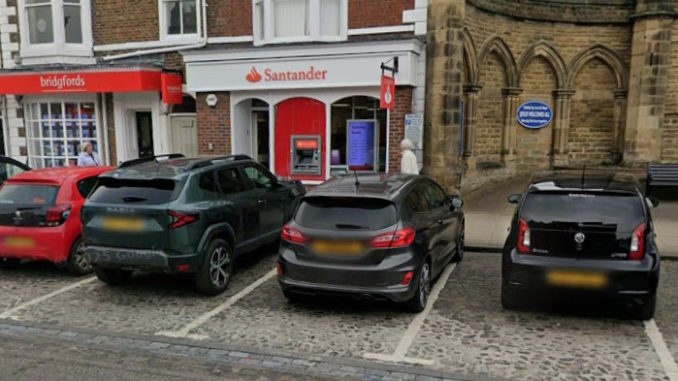
MP Rishi Sunak says he is seeking clarity about the data used to deny Stokesley a banking hub.
The Richmond and Northallerton MP has written to the bank organisation responsible for recommending that hubs are established asking for an explanation about how the decision was reached.
Stokesley’s last bank branch – Santander – closed in July last year. A review of the town’s ability to access banking services was carried out and it concluded no hub was needed.
Banking hubs – which major banks share to offer services from one building – have been established in a number of towns, including Richmond, to ensure continued access to cash handling and other services when bank branches close.
Decisions about which bank branch-less towns qualify for a banking hub are taken by LINK – a body established by the major banks to carry out cash access reviews of communities, typically when the last branch closes.
The review process looks at a number of factors, including population in and near the community, the number of businesses and what cash services, like ATMs, remain.
Cash access reviews were carried out in Richmond in September 2024 – at the time of the Barclays Bank branch closure – and in Stokesley – just before the Santander closure.
The Richmond review led to the opening of a hub in King Street in January this year (2025) which offers counter cash services, operated by the Post Office, and community bankers when representatives of the biggest banks are available on designated weekdays to provide face-to-face contact with their customers.
But the Stokesley cash access review decided that a similar hub was not required.
The need for a Stokesley banking hub has been raised with Mr Sunak by individual constituents and the area committee of North Yorkshire Council.
Mr Sunak said he had examined the two reviews and said it was not clear why Richmond had met the criteria for a hub and Stokesley had not.
He said: “Looking at and comparing the assessments for these two communities there a striking number of similarities in terms of the number of, and distance to, the nearest Post Offices and free-to-use ATMS, travel times to nearest bank branches and the rural nature of the areas served.
“One marked difference in the assessments is the number of adults who live near the High Street/town centres of these communities – 18,448 in the case of Richmond and 9,643 in Stokesley.”
Mr Sunak said these numbers were puzzling given that at the 2021 census Richmond’s population was 8,076 and Stokesley’s, when combined with the adjacent communities of Great Ayton and Hutton Rudby (both within four miles of Stokesley) was more than 11,000.”
He added that in the interests of transparency and the public’s faith in the assessment process, it would be helpful if LINK could explain how that figure of 18,448 for the population of Richmond was reached and to what extent it was a determining factor in the town meeting the criteria for a banking hub.
Neighbouring Catterick Garrison and Colburn could be a factor in the LINK review calculation but that was not made clear. Mr Sunak said he had written to LINK seeking clarification.
“Richmond’s banking hub – which I was proud to help open – has been very successful since it was set up at the beginning of this year, he said. “I think a similar hub in Stokesley would meet an obvious need.”
Mr Sunak’s intervention was welcomed by Cllr Sally Atkinson, chair of Stokesley Town Council.
She said: “We too have been puzzled as why Stokesley did not qualify for a banking hub, especially as on one measure in the review process – access to 24/7 ATMs – we are considerably worse off than Richmond.”
Be the first to comment