

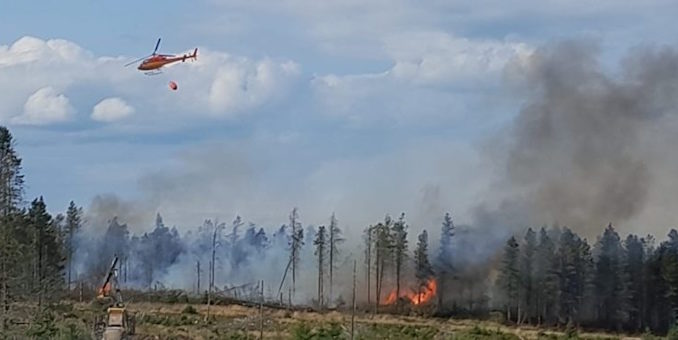
The huge Langdale Moor fire put significant pressure on North Yorkshire’s firefighters, with crews struggling to balance work to tackle the blaze with their normal duties and other employment, a report has revealed.
A review of the response to the Langdale and Fylingdales Moor fire has raised concerns about the demands placed on firefighters during prolonged emergencies and the impact on their welfare.
The findings are included in a report which will be considered by the York and North Yorkshire Police, Fire and Crime Panel next week.
The blaze started on August 11 last year and at its height, covered nearly 10 sq miles (25 sq km).
The fire, which burned for more than 40 days, was likely to have been caused by someone cooking using a campfire or gas burner, an investigation later found.
The report says the incident placed pressure on senior officers, full-time firefighters, on-call crews and volunteers.
The report acknowledges the exceptional commitment of on-call firefighters but says extended deployments began to affect their main jobs and their availability for other emergency duties.
It also raises questions about expectations for firefighters to continue working beyond their normal shifts.
As a result, the service has been advised to develop better arrangements for relieving and rotating crews during lengthy incidents to protect staff welfare and maintain emergency cover.
The findings come amid wider concerns about the availability of on-call firefighters across North Yorkshire, particularly in rural communities where fire stations rely heavily on personnel who have other jobs.
The report acknowledges that recruiting and retaining sufficient on-call firefighters remains a major challenge.
It noted that employment commitments, training requirements and difficulties filling specialist roles all contributed to the problem.
The report said particular difficulties existed in recruiting qualified drivers and supervisory managers, with more than half of on-call supervisors also holding full-time firefighting contracts.
However, the service says recruitment is improving.
A total of 53 new on-call firefighters have joined so far this year, compared with annual intakes of between 32 and 34 in previous years.
However, the report warned that new recruits require extensive training before becoming fully operational, meaning increased recruitment does not immediately translate into better emergency cover.
The service currently employs 306 full-time firefighters, 339 on-call firefighters and 14 volunteers, although some staff hold more than one role.
Absence is another concern, with long-term illness accounting for almost three-quarters of all working days lost through sickness during the first quarter of the financial year.
Despite the challenges, the report highlights improvements in recruitment, leadership and workforce management recognised by inspectors.
A review of future staffing requirements is underway.
Findings are expected before the end of the year.
The report will be considered by the panel on Wednesday, October 14.
Be the first to comment