

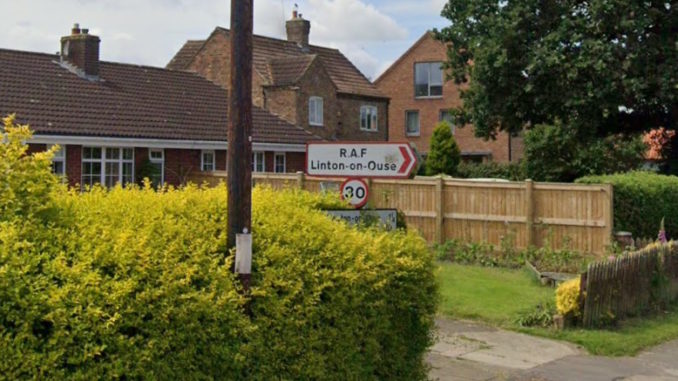
Questions have been raised over how long a proposed asylum centre at the former RAF Linton-on-Ouse base could actually operate after it emerged the site could be closed for the site to be redeveloped in less than three years.
Deputy mayor for policing, fire and crime, Jo Coles, has asked the Home Office to confirm in writing her understanding that, if the controversial proposals go ahead, the former RAF base would be returned to the Ministry of Defence for development by July 2029.
Crucially, Ms Coles said she understood that deadline would also have to allow time for the asylum accommodation and associated infrastructure to be decommissioned.
The potential end date appears to raise questions over the proposed lifespan of the centre, with the Home Office currently stating that, if approved, RAF Linton-on-Ouse would be used as asylum accommodation for a minimum of three years.
No final decision has yet been made on the proposals, which could see up to 1,200 single adult male asylum seekers accommodated at the site.
Feasibility work is continuing and any scheme would require the necessary planning permissions and approvals.
Following talks with the Home Office last month, Ms Coles has now sought clarification over the July 2029 date.
In correspondence with officials, she said: “Finally, as I said on the call, the mayor and I remain committed to the use of this site as a strategic site for housing in our region.
“From the call, my understanding is that the Linton-on-Ouse site, if approved, would be scheduled to return to the Ministry of Defence for wider development purposes by July 2029, which would enable housing development to move forward from that time.
“Can you confirm this timescale?
“We recognised that this timetable would also need to include a period for decommissioning the site and associated infrastructure, and I would welcome written confirmation that this remains the position.”
Mayor of York and North Yorkshire David Skaith opposes the asylum proposal and has called instead for housing-led redevelopment of the former airbase, saying the site could deliver thousands of homes as well as jobs and investment.
The Linton-on-Ouse Action Group says the potential July 2029 deadline raises serious questions over the viability and cost of the Home Office proposal.
Campaigners argue that planning, preparing the site, gradually increasing occupancy and ultimately dismantling the infrastructure could leave a much shorter period during which the centre was fully operational.
Professor Matthias, a spokesperson for the group, said: “The site usage was initially for three years but, as time goes by, more infrastructure and resourcing issues are being raised, making the window of opportunity much shorter and the cost per night much higher.
“Given the number of nights available, the phased process of moving asylum seekers, the period it will take for planning approval and the time and costs of estimated set-up and breakdown being fixed, this plan is not financially viable in any way.”
The group claims that under its revised calculations the cost could reach at least £853 per asylum seeker per night if the centre’s operational lifespan was reduced to around 20 to 22 months.
That figure is a campaign group estimate rather than a Home Office projection.
The Home Office previously said it did not recognise an earlier Action Group calculation which put the cost at more than £400 per person per night.
Ms Coles has also sought assurances that North Yorkshire Police would be reimbursed for all additional costs associated with the centre if it goes ahead.
She said: “Any decision must recognise the profound impact on this small rural community.
“It is essential North Yorkshire Police receive full cost recovery for additional policing, and that the Home Office provides transparency on operational practice, funding and the feasibility findings expected at the end of October 2026.”
The Home Office says feasibility assessments could take several months and that they do not predetermine whether the site will ultimately be used.
If deemed suitable, the site would accommodate single adult male asylum seekers aged between 18 and 65, with occupancy introduced in phases, government officials say.
Be the first to comment