

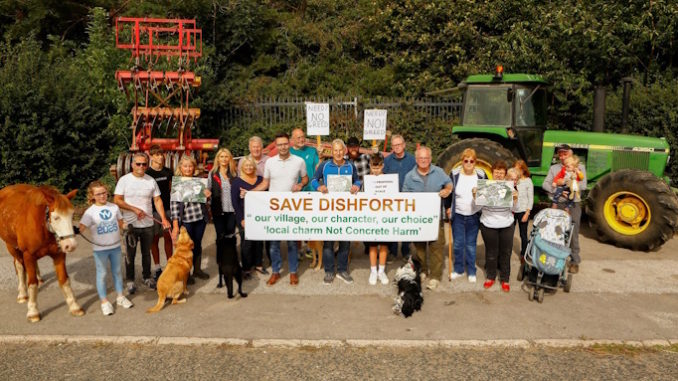
Councillors have been recommended to approve up to 98 new homes in a North Yorkshire village despite warnings that the development could reduce the quality of life for current and future residents.
North Yorkshire Council’s Skipton and Ripon area planning committee will meet next month to discuss the outline application for land off Topcliffe Road, Dishforth, between Ripon and Thirsk.
A report prepared for councillors recommends planning permission is granted for the scheme, arguing that the council’s severe shortage of housing land outweighs the objections raised locally.
The development has attracted significant opposition from residents with 130 objections submitted by the public.
Residents’ concerns included road safety, flooding, drainage, the loss of agricultural land and the impact on the character of the village.
Objections have also focused on the lack of public transport and walking and cycling links, with critics warning that Dishforth risks “being turned into a town”.
In its response to the plans, Dishforth Parish Council questioned whether the existing infrastructure could cope with the extra housing.
It said: “Essential services such as GP surgeries, dental practices, supermarkets, and petrol stations are all located outside Dishforth and are already under considerable strain.
“Without corresponding enhancements to these services, the proposed development risks exacerbating existing pressures and reducing the quality of life for current and future residents.”
Dishforth Residents Group also submitted an objection, stating that the village had already grown from 200 to 350 homes in just seven years.
But planning officers said that rules meant there was a “tilted balance” in favour of development because North Yorkshire could currently only demonstrate 2.2 years of housing supply against the government’s required five-year target.
The report concludes that although the site lies outside the village development limits, Dishforth was classed as a service village where new housing was considered sustainable in principle.
Officers added that the development would not be disproportionate when viewed against the size and role of the village.
Planning officers acknowledge the scheme would cause harm to the landscape and setting of the area.
The report states the development would create “major-moderate adverse” visual harm initially, reducing over time, and confirms there would also be “less than substantial harm” to the setting of the Grade II listed Crown Farmhouse.
However, officers argue these harms are outweighed by the public benefits, particularly the delivery of up to 98 homes, including 40 per cent affordable housing.
The report concluded: “When taking into account the benefits of the scheme, and the harms arising from the scheme, together with the housing land supply position of 2.2 years, I consider that the planning harms outlined above, would not significantly and demonstrably
outweigh the identified benefits.”
The application includes provision for a possible village shop, open space, a play area and biodiversity improvements exceeding the legal minimum requirements.
Highways officers and National Highways raised no objections to the scheme, subject to conditions and developer contributions towards bus service improvements.
Councillors will make the final decision at a planning meeting on June 2.
Be the first to comment