

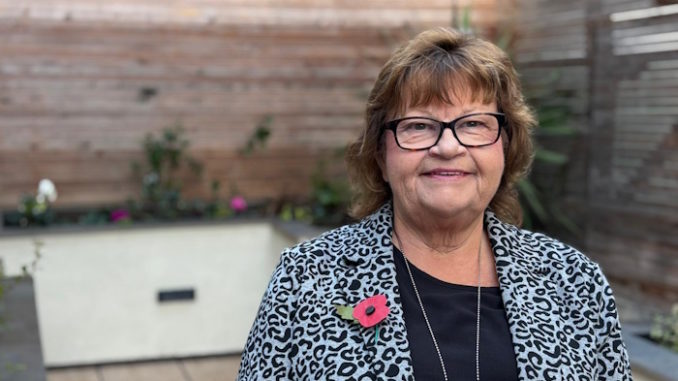
An NHS worker and grandmother-of-two is back on her feet – and back at work – just months after undergoing knee surgery at the Friarage Hospital in Northallerton.
Bev Dredge, who works as a general manager at the Friarage, has returned to full-time duties and is once again able to enjoy time with her two grandchildren following a successful operation and specialist recovery support through the national OPAL study.
Before surgery, Bev had been living with severe arthritic pain in her knee, relying on high doses of anti-inflammatory and paracetamol medication. She had also completed extensive musculoskeletal programmes and received steroid injections before being referred to orthopaedic surgeon Professor Paul Baker from University Hospitals Tees.
Ahead of her operation in 2023, Bev was contacted by the trauma and orthopaedic research delivery team at South Tees Hospitals NHS Foundation Trust and invited to take part in the OPAL study, which is funded by the National Institute for Health and Care Research (NIHR).
The study is designed to support patients undergoing hip or knee replacement surgery to return to work more efficiently. Recruitment for the trial was completed in September 2025, with 761 patients taking part across 19 NHS sites throughout the UK, including in Scotland and Wales.
Patients taking part in the study were randomly placed into two groups: one receiving standard care, and the other receiving a personalised OPAL return-to-work programme. Those on the OPAL programme were supported by a dedicated return-to-work coordinator, given access to tailored information and resources, and provided with an individual recovery plan.
Bev said:
“The care I have received from the wonderful surgeons who completed my operation, to the recovery care I received through the OPAL trial, has been nothing short of life-changing.
“Through the OPAL programme, I was given access to my own personalised recovery plan and was asked to complete questionnaires at certain milestones of my recovery, which really helped me track my progress.
“I also attended a patient group exercise class at The James Cook University Hospital. I was back driving after six weeks, working from home during this time, and then returned fully to work eight weeks after the operation with almost full range of movement.
“It has made a significant difference to my mobility. I am now able to work without restriction and no longer require pain relief or the use of sticks. Most importantly, I can get back to the thing I love most – playing with my two grandchildren.”
Professor Paul Baker, orthopaedic surgeon and chief investigator for the OPAL study, said he was delighted with Bev’s recovery.
“The trial is a great innovation that allows us to support patients with personalised plans to enhance their recovery and help them return to work sooner after surgery.”
Professor Anthony Gordon, programme director for the NIHR Health Technology Assessment programme which funded the study, added:
“Correct recovery and rehabilitation after surgery is absolutely crucial. Studies like OPAL enable the NHS to learn how best to support patients following hip or knee replacement surgery, helping them return to their normal day-to-day activities, including work, as swiftly and safely as possible.”
The OPAL study was developed by a team of researchers, academics and clinicians from the Academic Centre for Surgery, South Tees Hospitals NHS Foundation Trust, the University of York and the University of Nottingham.
All recruited patients will continue to be followed for 12 months after surgery. The results will assess whether the OPAL programme supports a safe and sustained return to work. If proven successful, the programme could be rolled out nationally across the NHS and shared with other specialities beyond orthopaedics.
The project is due to complete follow-up and report its findings in early 2027.
Be the first to comment